
The Current State of the Nepali Share Market
The share market in Nepal — embodied primarily by the Nepal Stock Exchange (NEPSE) — has increasingly become a focal point for investors, policy-makers, and ordinary citizens alike. In recent years, as digital access has improved and investor interest has surged, NEPSE’s role in Nepal’s economy has only grown. Yet along with the opportunities come structural challenges, regulatory questions, and risks that merit careful attention. This article sets out a detailed overview of the Nepali share market: its history, structure, current state, key drivers & hurdles, and what the future might hold.
NEPSE was officially incorporated on 13 January 1994, opening its trading floor for share transactions. (Wikipedia) Its core objective is to provide “free marketability and liquidity” to corporate and government securities by facilitating transactions through brokers and intermediaries. (shyamkumarkc20.com.np)
From its early days, NEPSE operated under the legal frameworks of the Companies Act, 2006 and the Securities Act, 2007. (shyamkumarkc20.com.np) Over time, technological changes have been introduced: for example, NEPSE adopted the automated trading system (NATS) in 2007, enabling screen-based trading. (shyamkumarkc20.com.np)
In terms of ownership, NEPSE is majority-controlled by public/government institutions: the Government of Nepal holds circa 58.66 % of NEPSE, while the Nepal Rastra Bank (NRB) holds around 9–10 %, the Employees Provident Fund about 10 %, and other banks or institutions the remainder. (Nepal News) This concentrated ownership underscores the semi-public nature of the exchange: NEPSE is neither fully privatized nor purely commercial.
From a listing perspective, as of mid-July 2025, NEPSE had 272 listed companies, covering sectors such as banking & financial institutions (BFIs), hydropower, manufacturing, hotels, investment companies, trading firms and others. The paid-up value of these shares stood at approximately NPR 869.86 billion.
NEPSE facilitates the trading of:
Participants in the market include brokers (licensed stockbrokers), investors (both institutional and retail), listed companies, and regulatory bodies. There are 92 registered brokers and 41 Remote Work Stations (RWS) across Nepal as of recent reports. (Meroshare.net)
The trading system is largely order-driven, executed via the automated trading system (NATS), and securities are held in dematerialised (Demat) form. (Wikipedia)
NEPSE tracks several indices including:
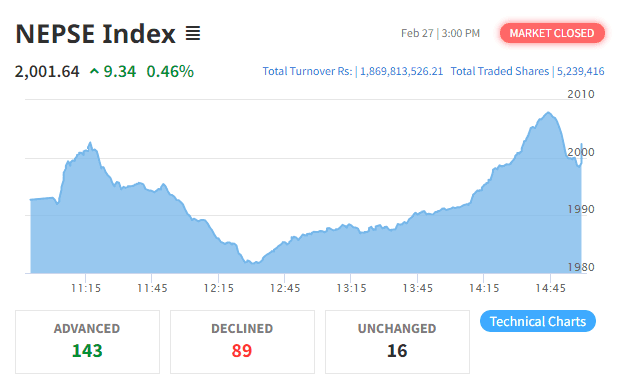
For example, as of 29 October 2025, the NEPSE Index value stood at ~2,558.42 points; the Banking sub-index at ~1,361.60; the Hydropower sub-index at ~3,271.19. (https://nepsekhabar.com)
As of mid-July 2025, the market capitalisation of NEPSE-listed companies stood at around NPR 4,656.99 billion (~US$34 billion depending on exchange rate) and the market-cap to GDP ratio was ~76.25 %.
Breakdown by sector (mid-July 2025):
This illustrates the dominance of the financial sector in Nepal’s listed market.
The Nepali share market has experienced periods of rapid growth. For example, around 2020-21, as pandemic measures eased and monetary policy relaxed, NEPSE saw strong upward movement. (Nepal News) On the other hand, during downturns — such as when interest rates rise, or liquidity is squeezed — the market has seen sharp corrections: e.g., the market-cap to GDP ratio fell from ~94 % to ~64 % between H1 FY22 and H1 FY23. (World Bank)
These data show that despite the large market-cap relative to GDP, daily liquidity and turnover remain modest — which can amplify volatility and risk.
Given the heavy weight of BFIs in market capitalisation (~54 %), movements in banking/finance stocks tend to drive the index significantly. In contrast, sectors such as hydropower, although growing, comprise a smaller share and often have different risk/return profiles. The hotels/tourism sector is still relatively small (~2.7 %) but may have potential pending structural improvements.
There has been a noted increase in retail investor participation, especially during and post the COVID-19 pandemic, with online brokerage access expanding and younger investors entering the market. (Learn Trading) However, there are concerns about investor education, speculative behaviour, and market manipulation (as captured in forums). For instance:
“NEPSE has been hijacked by some players…” (Reddit) “Nepse is overvalued … retail investors are becoming smarter and not buying shares at inflated prices.” (Reddit)
Sentiment plays a big role: rallies can form when investors hope for bonus shares, rights issues, IPOs. Conversely, when sentiment sours (due to economic slowdown, policy changes or corporate disclosures), the market can drop sharply. For example, NEPSE’s big surge in 2020 was followed by a significant correction. (Nepal News)
Although market capitalisation is large relative to GDP (~76 % in mid-2025) , actual liquidity (daily turnover, number of shares traded) is relatively low compared to more mature markets. This can lead to higher price volatility, wider bid-ask spreads, and difficulty exiting positions.
With BFIs alone accounting for over half the market capitalisation (54.1 %) in mid-2025, the market is heavily exposed to one sector. This concentration means any adverse developments in banking/finance can drag the whole market disproportionately.
The influx of retail investors, sometimes with limited financial literacy, raises the risk of speculative bubbles and losses. Reddit commentary captures this:
“Nepse is such a scam … most people lost about 2-3 lakhs.” (Reddit) Also, worries around market manipulation via share‐loan schemes and brokers with privileged information. (Reddit)
Nepal’s economy faces vulnerabilities: exposure to global commodity price shocks, natural disasters (earthquakes), currency depreciation, inflation, and political instability. These macro risks inevitably impact the share market. Historical evidence shows that during insurgency and economic slowdown (circa 2000-2002) NEPSE’s performance suffered. (Nepal Central Bank)
If you are a retail investor (in Nepal or abroad) considering exposure to the Nepali share market, here are some practical considerations:
| Strengths | Weaknesses | | ------------------------------------------------------------ | ------------------------------------------------------------------------------ | | Growing investor interest and participation | Low liquidity / market depth compared to global peers | | Large market-cap to GDP ratio (~76 % in 2025) showing scale | Heavy concentration in banking/finance sector (~54 %) | | Ongoing reforms (demat, derivatives, improved tech) | Governance, transparency, regulatory independence still weak (Nepal News) | | Digital brokerage access expanding | Macroeconomic vulnerabilities (currency, political risk, natural disasters) |
| Opportunities | Threats | | --------------------------------------------------------------------------- | ------------------------------------------------------------------------------ | | Entry of new instruments (ETFs, derivatives) may deepen market | Sudden policy changes or regulatory mis-steps undermining investor confidence | | Growth in hydropower, tourism, manufacturing offering new industry exposure | Over-speculation / manipulation risk harming credibility (Reddit) | | Increased financial literacy & retail investor base | Global shocks (commodity price, interest rates) impacting Nepal’s open economy |
One key factor is how effectively Nepal implements capital-market reforms: dematerialisation, investor protection laws, transparent monitoring of brokers/insiders, allowing greater foreign participation, and introducing new instruments. If these reforms accelerate, market efficiency and confidence could improve significantly.
If sectors beyond banking/finance begin to gain prominence (e.g., hydropower, manufacturing, technology) in the listed arena, NEPSE might become more balanced and less vulnerable to singular sector shocks. The rise of hydropower listed firms is promising but requires operational stability, regulatory certainty and profitability.
Deepening the investor base — both domestic (retail + institutional) and foreign — can enhance liquidity. Better trading infrastructure (faster systems, improved mobile/online access) will help. Many retail investors still face usability or informational barriers. Addressing these will help.
Nepal’s macro conditions (inflation, exchange rate, remittances, interest rates) will continue to shape the share market. A stable macro environment reduces systemic risk and allows investors to focus on company fundamentals rather than external shocks.
Market integrity (fair trading, timely disclosures, crackdown on manipulation) is vital for confidence. As the Reddit commentary suggests, many investors believe manipulation and insider benefit are significant problems. (Reddit) Improving this area could attract more long-term capital.
The Nepali share market — centred on NEPSE — presents a compelling yet nuanced proposition. On one hand, its scale relative to GDP, growing investor interest, and ongoing reforms point to meaningful potential. On the other, the structural constraints (liquidity, concentration, transparency) and macro-economic risks act as significant brakes.
For investors willing to engage with the Nepali market, the opportunity is real — but so too is the need for caution, diligence, and a long-term perspective. As Nepal’s economy evolves, as reforms are implemented, and as digital access broadens, we may yet see the share market become a more robust vehicle for wealth creation and corporate finance alike.
If I were to summarise in one line: “The Nepali share market is an emerging frontier — open for growth, but requiring maturity.”
If you like, I can pull together recent performance charts, sectoral breakdowns, and a comparison with other regional markets (e.g., stock exchanges in South Asia) to create a richer appendix for this article. Would you like me to add that?